Research
Teaching a Computer to Land on the Moon: A Reinforcement Learning Story
15 January 2026 · reinforcement learning · lunar lander · tutorial · decision intelligence
The Challenge: Landing on the Moon Without a Pilot’s Manual
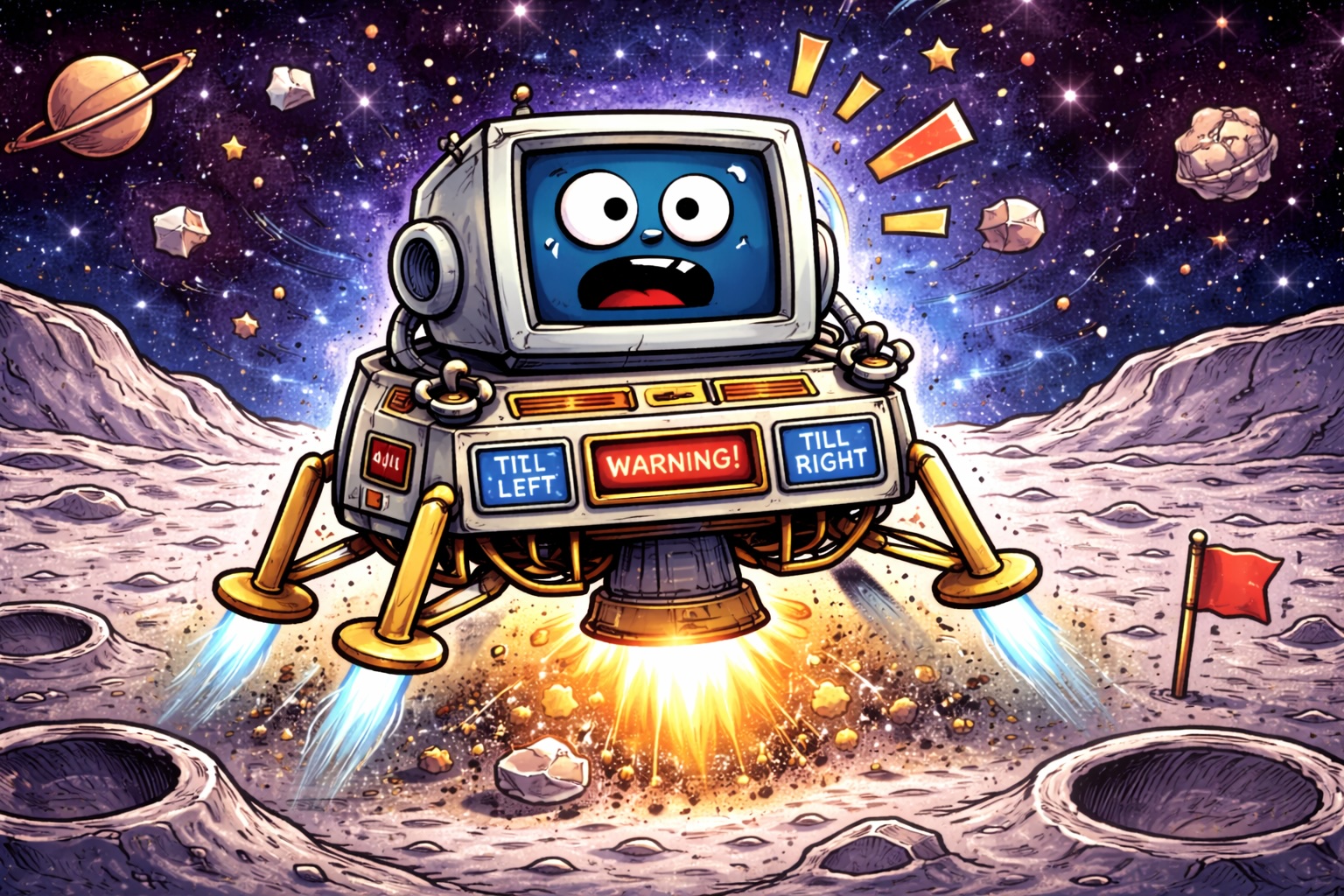
Imagine you’re sitting in a lunar lander, hovering above the moon’s surface. You have three engines at your main thruster pointing down, and two side thrusters for tilting left or right. Your fuel is limited. The moon’s gravity is pulling you down. One wrong move and you’ll either crash spectacularly or drift off into space, wasting precious fuel.
Now imagine you’ve never done this before. No flight school, no instructor, no manual. Just you, the controls, and the unforgiving physics of spaceflight.
This is exactly the problem we give to a reinforcement learning (RL) agent. And remarkably, it learns to land perfectly—not by reading instructions, but by crashing thousands of times until it figures out what works.
What Can the Lander Actually Control?
Think of the lunar lander as having a simple but challenging control panel with just four buttons:
- Do Nothing - Coast and let physics do its thing (sometimes the best move is no move)
- Fire Left Thruster - Tilt and push right
- Fire Main Engine - Thrust downward (costs more fuel)
- Fire Right Thruster - Tilt and push left
That’s it. Four discrete actions. No joystick finesse, no gradual throttle control—just four buttons. It’s like playing a video game from the 1980s, except the physics are brutally realistic.
The lander constantly receives information about its current state:
- Position (x, y coordinates)
- Velocity (how fast it’s moving horizontally and vertically)
- Angle (tilt relative to vertical)
- Angular velocity (how fast it’s rotating)
- Leg contact (whether landing legs are touching the ground)
- Fuel remaining
Every 50 milliseconds, the agent looks at these numbers and picks one of those four buttons to press. That’s roughly 20 decisions per second during the descent.
The Reward System: Teaching Through Consequences
Here’s where it gets interesting. How do you teach a machine what “good landing” means? You can’t just tell it, you have to show it through consequences, like training a puppy with treats and corrections.
The reward system works like this:
Positive rewards (treats):
- Moving toward the landing pad: +small reward
- Landing softly between the flags: +100 to +140 points (jackpot!)
- Each leg making contact with the ground: +10 points
Negative rewards (corrections):
- Firing the main engine: -0.3 points per frame (fuel is expensive!)
- Firing side thrusters: -0.03 points per frame (cheaper, but still costs)
- Crashing: -100 points (game over, bad!)
- Drifting away from the landing zone: -small penalties
Think of it like a driving instructor who gives you points for smooth braking and staying in your lane, but deducts points for harsh acceleration and speeding. The difference? This instructor is willing to let you crash millions of times until you get it right.
How Does the Agent Learn? The Power of Trial and Error
This is where reinforcement learning becomes magical. The agent doesn’t start with any knowledge about physics, gravity, or thrust. It begins completely randomly—imagine a small child pressing buttons on a game controller.
Early attempts (Episodes 1-1000): The lander fires thrusters randomly, spinning wildly, sometimes boosting directly into the ground at full speed, sometimes floating off into space. It’s chaos. But here’s the key: after each episode, the agent remembers what happened and slowly starts to recognize patterns.
“Hmm, when I was tilted 45 degrees to the right and fired the left thruster, I spun even faster and crashed. Bad. When I was falling fast and fired the main engine, I slowed down and got positive points. Good!”
The Learning Algorithm (typically DQN - Deep Q-Network): The agent uses a neural network to learn a “value function”—basically, a sophisticated guess at “if I’m in this situation, and I press this button, how many points will I likely get in the long run?”
After every crash, every successful landing, every fuel-wasting drift into space, the network updates its understanding. It’s like building a mental database of experiences:
- “When falling fast near the ground → fire main engine = high value”
- “When tilted too far → fire opposite thruster = high value”
- “When stable above landing pad → do nothing = high value”
- “When drifting left → gentle right thrust = high value”
Middle training The agent starts figuring out the basics. It learns that hitting the ground too hard is terrible. It discovers that the main engine can counteract falling. It begins to understand that tilting affects horizontal movement. The success rate climbs from 0% to maybe 20%.
Advanced training Now the magic happens. The agent develops strategy. It learns to:
- Approach at an angle and curve into the landing zone (like a real spacecraft!)
- Balance fuel efficiency against safety
- Make tiny corrective adjustments
- Even handle tricky starting positions (spawning far from the pad, falling fast, tilted awkwardly)
By the end, it lands successfully 95%+ of the time, often more gracefully than a human player could manage.
The Beautiful Part: Emergent Behavior
Nobody programmed the lander to “approach at a 30-degree angle then straighten out at 50 meters altitude.” Nobody told it to “conserve fuel in the early descent.” These strategies emerged naturally from the simple reward structure.
It’s like teaching a chess engine by only telling it “checkmate = win, everything else = keep playing”—and watching it discover opening theory, tactical patterns, and endgame technique entirely on its own.
The agent learns to land on the moon the same way humans learn to ride a bike: through thousands of attempts, feeling out cause and effect, building intuition from experience rather than following instructions.
Why This Matters Beyond Video Games
The Lunar Lander problem is a classic RL benchmark for good reason. It captures many real-world challenges:
- Continuous physics with discrete decisions (like choosing when to brake while driving)
- Delayed consequences (early fuel waste affects late-stage options)
- Safety-critical outcomes (crash vs. success has huge consequences)
- Resource constraints (limited fuel forces strategic thinking)
The same principles that teach an agent to land on the moon can help systems:
- Optimize energy consumption in data centers
- Plan aircraft trajectories for fuel efficiency
- Control robotic systems in manufacturing
- Assist in medical treatment planning
- Learn to dispatch personelle in a complex working environment
The Lunar Lander is a sandbox where we can perfect these techniques safely, cheaply, and at unlimited scale—crashing a million virtual landers until we understand how to build systems that make good decisions when it really matters.
Try It Yourself
Want to see this in action? The Lunar Lander environment is freely available through the Gymnasium library. You can watch untrained agents flail helplessly, then witness the gradual emergence of skill over thousands of episodes. There’s something mesmerizing about watching intelligence bootstrap itself from pure randomness.
Or better yet: train your own agent and watch it discover its own landing strategies. Will it learn the same techniques, or find creative solutions you never expected?
That’s the beauty of reinforcement learning—the solutions aren’t programmed. They’re discovered.